
Blog
The DTI E-Commerce Philippine Trustmark: What Online Businesses Need to Know


As more Philippine businesses scale online, growth often happens faster than systems. Sales increase, platforms multiply, and customer reach expands. What does not always keep pace is structure: registrations, complaint handling, and accountability mechanisms that support long term trust.
The DTI E-Commerce Philippine Trustmark was introduced in this context. It is not simply a badge for online sellers. It reflects a broader shift in how e-commerce is expected to operate in the Philippines, particularly for businesses moving beyond informal selling.
For founders and operators, the Trustmark raises a practical question. Is your business set up to handle consumer transactions at scale, not just to generate them?
This article explains what the Trustmark is, why it exists, what it requires in business terms, and how Philippine online sellers can assess readiness without overbuilding compliance.
Why the DTI E-Commerce Trustmark exists
Philippine e-commerce growth has been rapid, but consumer trust has not grown evenly across the market. Buyers continue to encounter familiar issues: sellers that disappear after payment, delayed or incorrect deliveries, difficulty securing refunds, unclear complaint channels, and concerns over personal data use.
The Trustmark reflects a policy shift where government is no longer focused only on encouraging digital commerce but also on accountability and consumer protection in online transactions.
Anchored on the Internet Transactions Act of 2023 and implemented through DTI administrative rules, the Trustmark supports a simple policy objective: online consumers should know who they are dealing with, and online sellers should be capable of resolving disputes fairly and consistently.
For businesses, this signals a clear change in expectations. Selling online is no longer treated as a casual extension of offline trade. Once a business accepts consumer money online, it is expected to be identifiable, reachable, and operationally prepared to handle problems.
What the Trustmark is and what it is not
What the Trustmark represents
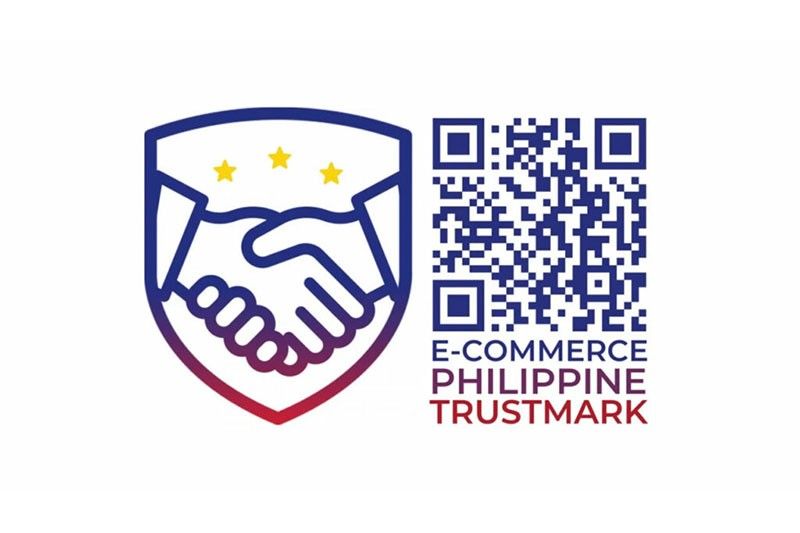
The DTI E Commerce Philippine Trustmark is a government issued digital badge for qualifying online businesses. It indicates that the seller has undergone verification and has committed to comply with consumer, e commerce, and tax rules, as well as basic standards of good online selling practice.
The Trustmark is displayed on approved websites, online stores, or marketplace seller profiles. It links to a government maintained database where consumers can verify the business.
In practical terms, it is a public trust signal backed by verification, not marketing claims.
What the Trustmark does not do
The Trustmark does not replace business permits, licenses, or registrations. It does not exempt businesses from other regulatory obligations. It does not guarantee that complaints will never arise. It is a baseline indicator of accountability, not a certification of performance or service quality.
Who can apply for the Trustmark
Businesses engaged in e-commerce and covered by the Internet Transactions Act may apply. This includes sellers operating through their own websites, social commerce channels, or third party marketplaces.
Applicants must operate a legitimate online business, agree to DTI evaluation and monitoring, and execute a sworn undertaking to comply with applicable laws.
Trustmark requirements explained in business terms
The Trustmark application has a defined documentary checklist. The challenge is rarely the number of documents, but whether a business has kept its operations aligned as it grows.
| CORE DOCUMENTS | WHY THEY MATTER |
|---|---|
| ✓ Business registration documents | These establish the legal existence of the business and identify who is responsible for it. |
| ✓ BIR Certificate of Registration with the correct line of business | This confirms that tax registration reflects actual online selling activities. Many scaling businesses encounter friction here, particularly those that started informally or expanded beyond their original scope. |
| ✓ List of websites and platforms used for selling | This defines where the Trustmark may be displayed and what channels fall within the scope of verification. |
| ✓ Identification of the owner or authorized representative | This links the online store to a real person who can be held accountable. |
| ✓ Internal Redress Mechanism for consumer complaints | This is the most operationally significant requirement and the one that most clearly separates prepared sellers from unprepared ones. |
The Internal Redress Mechanism as a business system
The Internal Redress Mechanism, or IRM, is a written process explaining how a business handles consumer complaints. It is mandatory, but more importantly, it reflects how a business treats customers when transactions do not go as planned.
A strong IRM does not need to be complex. It needs to be realistic, consistently followed, and aligned with how the business actually operates.
From a commercial perspective, the IRM is not just a compliance document. It is a customer experience discipline that protects conversion, repeat purchases, and brand credibility.
Key elements of a workable IRM
| ✓ Clear complaint channels | Customers should know exactly where to raise issues. Businesses often weaken their position by spreading complaints across multiple inboxes or platforms without a central view. |
| ✓ Defined timelines | Acknowledgement, investigation, and resolution timelines should be set based on what the team can actually meet, not ideal scenarios. |
| ✓ Available remedies | Refunds, replacements, repairs, or other solutions should be clearly explained. Inconsistent or ad hoc remedies are one of the most common sources of escalation. |
| ✓ Escalation structure | There should be clarity on when issues move beyond front line support and who has authority to decide. |
| ✓ Documentation and review | Complaints should be recorded and reviewed periodically. Patterns often point to listing issues, courier problems, or supplier gaps that can be fixed upstream. |
Many online sellers already perform these steps informally. The IRM requires discipline and consistency, not reinvention.
Which businesses find the Trustmark easier to obtain
Businesses with aligned registrations, stable operations, and existing customer support workflows generally experience smoother applications. These include established SMEs and brands selling through a limited number of channels.
Consistent store naming, centralized complaint handling, and basic refund policies already put these businesses close to Trustmark readiness.
Where businesses typically struggle
Scaling sellers often face difficulty when growth outpaces structure. Common issues include outdated registrations, mismatched store names across platforms, fragmented complaint handling, and undocumented refund decisions.
Businesses with multiple sales channels or reseller networks may also need additional controls to ensure the Trustmark is used correctly and consistently.
Application process, timing, and renewal planning
Applications are submitted through an online portal. The DTI reviews submissions and may request clarification or additional documents before approval.
Prepared businesses should expect a review period that allows for document checks and follow ups. The Trustmark is typically valid for one year and must be renewed.
Renewal should be treated as part of the annual compliance cycle, not as a last minute task. Ownership should sit with a function that can enforce complaint handling discipline, such as operations, customer experience, or compliance.
Benefits and burdens in practice
| Benefits | Burdens |
|---|---|
| Formally, the Trustmark provides government recognition and access to certain DTI programs. Practically, it supports consumer confidence, particularly for first time buyers, higher value transactions, and cautious customers. | The Trustmark requires documentation, consistency, and monitoring. Businesses must maintain their IRM, respond to complaints within set timelines, and avoid misuse of the badge. |
| For serious online sellers, it helps distinguish structured businesses from informal operators. | Failure to do so carries reputational and operational risk. |
Risks of non compliance and misuse
The Trustmark may be suspended or revoked for false application information, misuse of the badge, failure to maintain legal compliance, repeated unresolved complaints, or refusal to cooperate with monitoring.
Suspension or revocation requires removal of the badge and can undermine consumer trust, particularly if it occurs after public complaints.
Final thoughts for online sellers
The DTI E Commerce Philippine Trustmark reflects a broader shift in how digital commerce is regulated in the Philippines. Trust and accountability are no longer optional signals. They are becoming baseline expectations for businesses that scale online.
For founders and operators, the decision is not simply whether to apply for the Trustmark, but whether internal systems are ready to support the commitments it represents.
For businesses that want a clear, practical path to Trustmark readiness, AJA Law can assist with document readiness checks, Internal Redress Mechanism drafting, and a focused review of consumer complaint workflows. You may contact us through our website contact form.
If you require legal guidance on your matter or situation
Work WITH OUR TEAM